





Capabilities
Home > Capabilities
For every client brief, we use qualitative, quantitative, and desk research, supported by AI and expert human insights in business and marketing.
Over 15 years, we’ve developed methods to uncover consumer beliefs, assess brand value, and optimize product and service design. We use elicitation techniques and analytical frameworks for marketing and product design, some of which are detailed below.
Motivational Frameworks
Based on extensive research and affinity group insights, consumer motivations are grouped into key themes to guide product development and marketing.
This framework helps clients better understand their customers and communicate effectively with marketing teams.
The meaning of the Motivation Framework in the financial news context I want stimulation
One of the strongest desires in financial news consumption serves to stimulate and to serve peoples’ personal interest in topics and subject matter. Among this target there is a genuine thrill in having their chosen newsfeed topics delivered to their device.
Content and features of interest and relevance to reader, industry-specific sections (e.g. Forbes Technology)
Weekend reading, e.g. more relaxed and extended articles for more in-depth
To seek a ‘more worldly’ outlook
Writing style, e.g. some publications considered too dry, boring, or ‘not for them’
‘British humour’, e.g. in the Economist
Satirical aspects of magazines
If it is to do with my industry, I might already hear about it… So, it is more about enjoyment
Personal Development, NY
Writing style, e.g. wit or humour can be incorporated to help ‘stimulate’; apart from content / features relevant to reader, people seek the ‘unexpected’, e.g. unusual articles, surprises. Examples like ‘The Sunday Style Section’ of the NYT – more lighthearted. Websites & mobile apps need to recognize which country the reader is in, and tailor news accordingly
Customer And User Experience
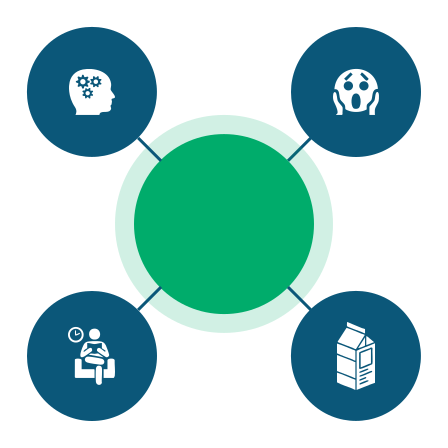
Customer research has evolved beyond traditional satisfaction metrics and Net Promoter Scores. In many industries today, a customer’s likelihood to try, use, and repurchase a product or service largely depends on its ease of use.
Novema utilizes a ‘Customer Effort’ framework to thoroughly examine how
product and service interactions challenge the customer.
Constituent elements of Customer Effort
Customer
Effort
Cognitive Effort
Examples:
- Software /IT
- Website usability
- Application forms
Emotional Effort
Examples:
- Dealing with fraud
- Risk / uncertainty
- Insurance claims
Time Effort
Examples:
- Waiting / queuing
- F&B: Instant noodles, microwave meals,
take away, delivery
Physical Effort
Examples:
- No need to go anywhere
- Packaging
- Luggage design

Customer Effort
Cognitive Effort
Examples:
Software /IT
Website usability
Application forms
Emotional Effort
Examples:
Dealing with fraud
Risk / uncertainty
Insurance claims
Time Effort
Examples:
Waiting / queuing
F&B: Instant noodles, microwave meals, take away, delivery
Physical Effort
Examples:
No need to go anywhere
Packaging
Luggage design
Market Entry Strategy
Our Route2Market method guides clients through risks of entering new markets or products by assessing opportunities and threats at each stage.
Novema incorporates desk research, AI, trade interviews, competitor analysis, and customer research.
AI Assisted Research
Novema is a lean, nimble consultancy where senior management is involved at every key project stage.
We use AI to support human researchers, blending AI’s speed with human expertise. Our agentic AI tool helps deliver faster, more cost-effective projects with deeper insights.