By, Piers Lee, Managing Director, Novema, Pte Ltd.
November 2025
A survey on AI conducted among market research industry stakeholders at the end of 2024 highlighted a wide range of perceived benefits and drawbacks of AI in market research.
The leading perceived benefit, by a considerable margin, is AI’s ability to generate efficiencies and accelerate the project cycle. This also relates to cost savings, including the reduced need for traditional surveys through the use of synthetic data.
Improved survey quality control also ranks highly among the perceived benefits, demonstrating how AI can spot errors or poor-quality responses. Related to this is AI’s potential to enhance the respondent experience, improve survey design, and reduce human bias in research at both the front and backend.
Stakeholders also identified a range of value-adding benefits, such as extracting more insights from existing research, enabling enhanced consumer profiling, and providing expanded services including better access to niche audiences or even extending research firms’ offerings into campaign development.
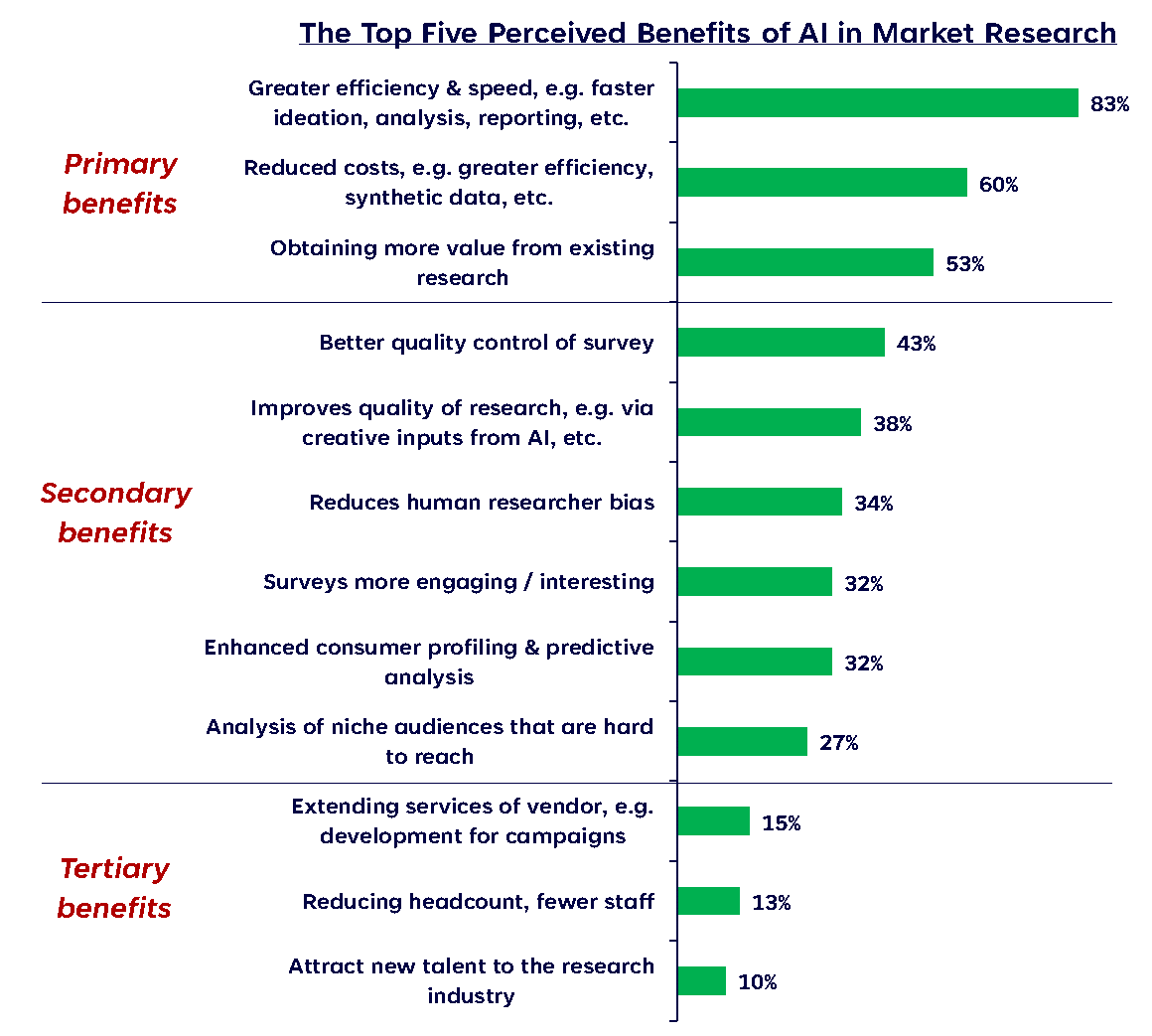
Benefits to HR were noted as well, such as reducing the number of staff needed for recruitment or training, and AI’s ability to attract new talent to the industry, particularly those working in new technology fields.
Many efficiency gains are expected to be realised in qualitative research, for example through faster text analysis and improved handling of multiple languages, such as for coding.
This also applies to desk research, which is typically labour-intensive when reviewing numerous sources.
AI shortens the project cycle, for instance by reducing timeframes for IDIs and brainstorming sessions. By freeing up more time, it enables researchers to “explore previously impossible tasks.”
Additionally, AI can act as a “sparring partner” in creative development, such as questionnaire design, creating JTBD frameworks, and generating visual stimuli for research.
AI can also extract more value from existing research for example, by analysing findings across multiple past reports. Clients may use this capability to synthesise results from reports from multiple vendors.
Many stakeholders recognize the importance of AI in improving both the respondent survey experience and overall QC.
AI enhances analysis and interpretation, not only within single datasets by identifying patterns humans may miss, but also by integrating insights from multiple data sources and historical data across accumulated reports.
Its application to competitor insight expands researchers’ reach, enabling analysis across more markets than would be feasible through human-only effort.
AI functions as a “smarter Google,” interrogating data and offering thematic insights beyond what traditional search tools can provide, while reducing biases often present in qualitative research and delivering clearer, more objective interpretations.
AI can also incorporate external perspectives, adding further value and ensuring balanced analysis. It helps researchers use findings more effectively, freeing time for strategic thinking and application.
Additional stakeholder comments suggest that AI brings data to life in new and innovative ways, making insights more actionable and focusing attention on the most relevant information.
Synthetic data, particularly “synthetic boosts”, can support analysis of niche audiences that are difficult to study using conventional survey methods. It can also generate personas and simulate human behaviour.
While some believe AI could negatively impact research firms, for example, by enabling clients to insource more work. It could also create opportunities for firms to expand their services, e.g. AI can generate creative stimuli and potentially replace some tasks typically handled by creative agencies, enabling research firms to develop initial creative concepts in-house.
Efficiency gains may allow firms to operate with fewer staff, contributing to cost reductions. However, relatively few firms were willing to state that they intend to reduce headcount through AI adoption.
New roles, such as Prompt Engineers, are emerging to optimise AI tools, and specialists are needed increasingly to refine AI-generated outputs, helping businesses achieve better results.
AI’s ability to enhance insights and streamline processes may also help attract new talent to the industry by creating opportunities for innovation and making research more appealing to a broader range of professionals.
Perceived benefits of AI to the individual researcher
In terms of how AI can benefit individual researchers, the perceived advantages generally mirror the broader benefits to the sector, for example, efficiency gains and support with ideation, design, and research delivery.
Many also view AI as a tool to improve their own writing skills, such as enhancing grammar, storytelling, and summary creation. Clients similarly recognise the value of using AI to generate clearer overviews of research for internal dissemination, which is particularly useful when sharing findings with staff whose first language is not English.
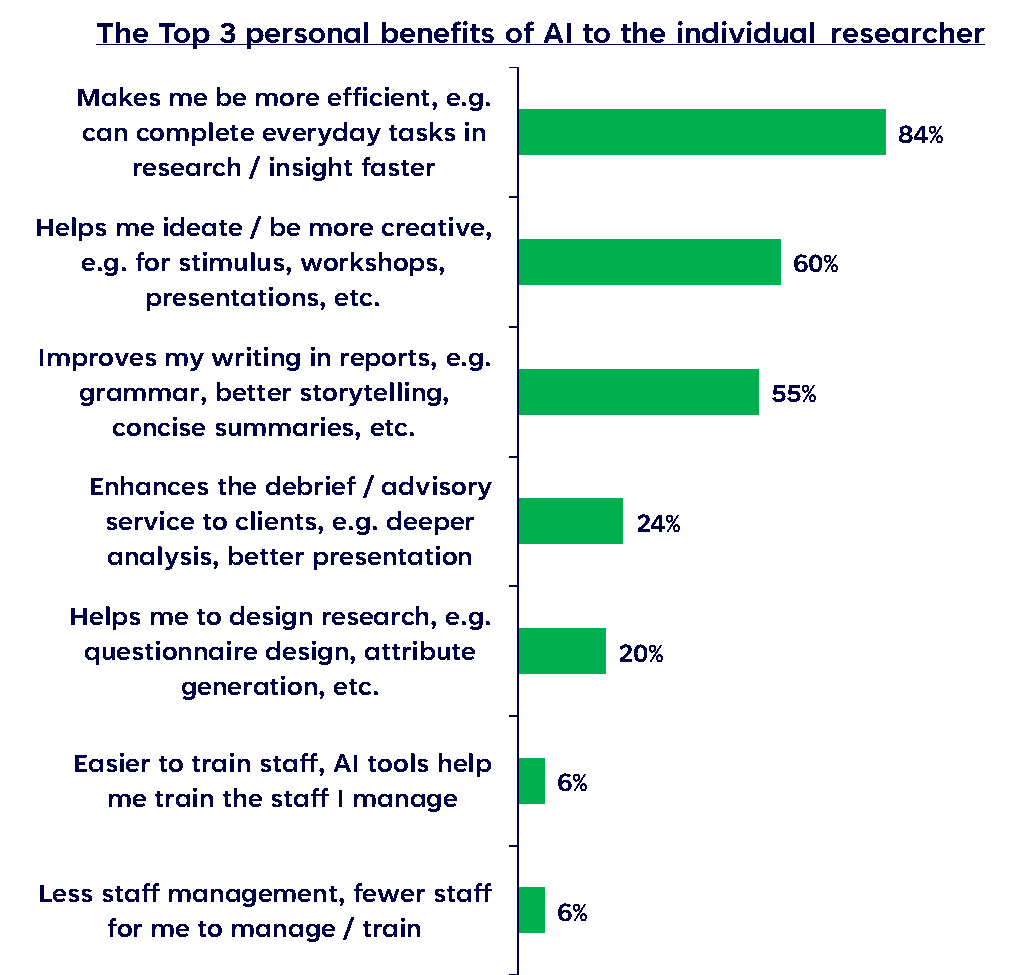
Perceived benefits of AI in HR applications are more limited. Only a few stakeholders commented that AI could help them manage or train staff or reduce the number of staff they need to manage in the first place.
Differences between senior management and executives are minimal. Executives see somewhat greater personal benefits from AI in improving their report writing (63%) and in research design (26%), whereas senior management perceive more value in using AI to enhance their debriefs and advisory services to clients (29%). These differences generally reflect their respective roles and responsibilities.
Note that the perceived drawbacks of AI to the industry are reported in a separate blog to this.