By, Novema Pte Ltd, May 2026
The Asia Research AI stakeholder survey in April 2026 showed that 98% of insight firms and departments are now using AI. Among organisations on the supply side, such as agencies and research technology (restech) companies, 16% say AI is central to their product proposition, while a further 29% report that AI is frequently promoted as part of their value proposition.
Researchers are applying AI across a wide range of use cases. The most common applications include desk research, e.g. scanning findings across multiple sources (71%), idea generation (65%), questionnaire design (63%), automated insight generation (62%), and automated transcription (61%). A smaller proportion (29%) are also using AI to develop research stimulus materials, such as generating images for prompts. However, this is expected to become one of the fastest-growing applications of AI in the future with an expected 34% growth.
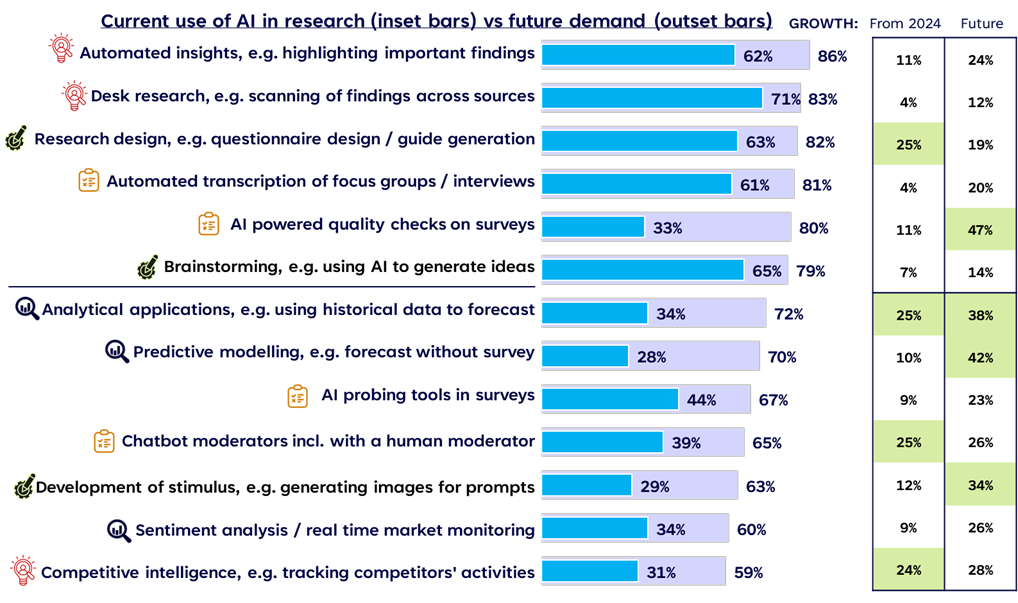
Since 2024, the use of chatbot moderators alongside human moderators has grown by 25%, with 39% of researchers now using them. In addition, 44% are using AI probing tools in surveys, often associated with “qual-at-scale” approaches in online research.
Around half of researchers (53%) are currently using AI in analytical applications, including forecasting based on historical data (34%), sentiment analysis and real-time market monitoring (34%), and predictive modelling that does not rely on surveys (28%). These are also expected to be among the fastest-growing AI applications going forward.
While both current and future growth in quantitative AI applications remain strong, the use of synthetic data appears to have stalled. There has been an increase in the proportion of researchers who say they are unlikely to use synthetic data in the future, suggesting growing scepticism around this more controversial application of AI. Market feedback also indicates that synthetic data can be a “harder sell” to internal stakeholders within client organisations.
Notably, qualitative researchers appear to be adopting AI more extensively than their quantitative counterparts. At the same time, many firms continue to position themselves around “human-led insight”, often claiming that AI plays only a minimal role in their work. In practice, AI may already be far more deeply embedded in agency workflows than some firms publicly acknowledge.
Although less frequently highlighted among the primary benefits of AI, 29% of researchers believe AI has the potential to broaden research agencies’ offerings into areas such as creative development, while 19% anticipate it could help attract new specialised talent to the industry.
In the near term, one of the most significant applications of AI is its ability to make research outputs more creative and engaging, for example through improved graphics, visualisations, and illustrations.
Overall, AI adoption is already widespread across the research project lifecycle, with particularly strong penetration in qualitative research. Key applications include research design, idea generation, chatbot moderation, “qual-at-scale” methodologies, automated insight generation, and more creatively designed AI-assisted reports.
The next stage of development is likely to focus more on quantitative applications, for example forecasting and predictive modelling, real-time market monitoring, and competitor tracking.
Over time, it remains to be seen whether research agencies will increasingly expand into territories traditionally occupied by creative agencies and management consultancies, where there is potential to provide campaign development, packaging strategy, and strategic consulting to clients. The question is how these players would respond to the competition from insight agencies.