By Piers Lee, Managing Director, Novema Pte Ltd
System 1 thinking: a fast process; it happens automatically, intuitively, emotionally, and with less effort.
System 2 thinking: slower and requires more effort. It is conscious and logical.
In the last 15 years or so, much of System 2 thinking in market research has been discredited. Many argue that market research interviews, focus groups, and online surveys produce too much System 2 responses that do not reflect what consumers will ready do in real life. For many categories, we agree, particularly in FMCG that are often instantaneous purchases with little effort. Even if we are making more ‘effort’, for example in deciding to buy something new or to switch to a new brand, our underlying decisions to do so can be quite illogical.
So much effort has been directed towards getting a better understanding of System 1 think (even companies going to far as to rename themselves after such a quest!), we might have forgotten a bit about when System 2 thinking counts, and how best to evaluate it.
Clearly, purchases that has a drawn-out process, or where people can be advising on options, involve more of the System 2 thinking. Examples include buying a house, some financial services purchases, choosing a holiday, and purchases made by businesses. What these all have in common is purchases are a higher value, are more complex, and often involve others in the process. That said, irrationality, intuition, and emotion still creep into decision-making even for these categories.
One of Novema’s specialist research areas is with international schools. Decisions parents make on choosing schools is again a high value purchase decision – an enrolment for eight years for a secondary school in Singapore can be a S$300k-400k purchase decision. Trade-offs need to be made in choosing schools, e.g. curricular options, facilities, length of commute, school fees, etc. Hence parents spend a lot of time and do a lot of research to make their final decision on schools.
Each year, Novema conducts a market wide survey of parents in SE Asia to assess the brand equity and image of the leading international schools in major markets. In addition, each year we look at factors that can affect how parents make choices on schools. In our recently completed 2023 survey, we assessed how parents make trade-offs on various elements of the school value proposition.
Conjoint is often used to assess the relative importance of attributes, but sometimes the conjoint approach can be unrealistic when asking people to state a relative preference between just two parameters in a series. It can be better for consumers to see what they are trading off in ‘totality’ as this then shows them the end-product they are buying for themselves.
The approach that Novema took for international schools was to ask parents in an online survey to ‘construct’ their optimum school based on a limited budget. This involved getting parents to spend 10 units (their ‘budget’) across 5 ‘added value’ elements of a school proposition including academics, the teaching of ‘life skills’, parent service, sports, and arts.
With 10 units across 5 elements, it was quite easy for parents to undertake trade ups and trade-offs. Essentially a spend of 2 units would indicate the parent viewed the importance of this element as equal to others, any trade up in one area would ‘force’ a parent to trade down in another.
Prior to the exercise, a monadic rating was asked on each attribute to see how the stated importance compared to the trade-off. We found that initially parents had given equal if not higher importance to the teaching of life skills compared to the core academics. The trade-off exercise then revealed how much more parents expect the school to invest in academics over life skills teaching. The trade-off also revealed how much more important sports is to arts, at least at an overall market level.
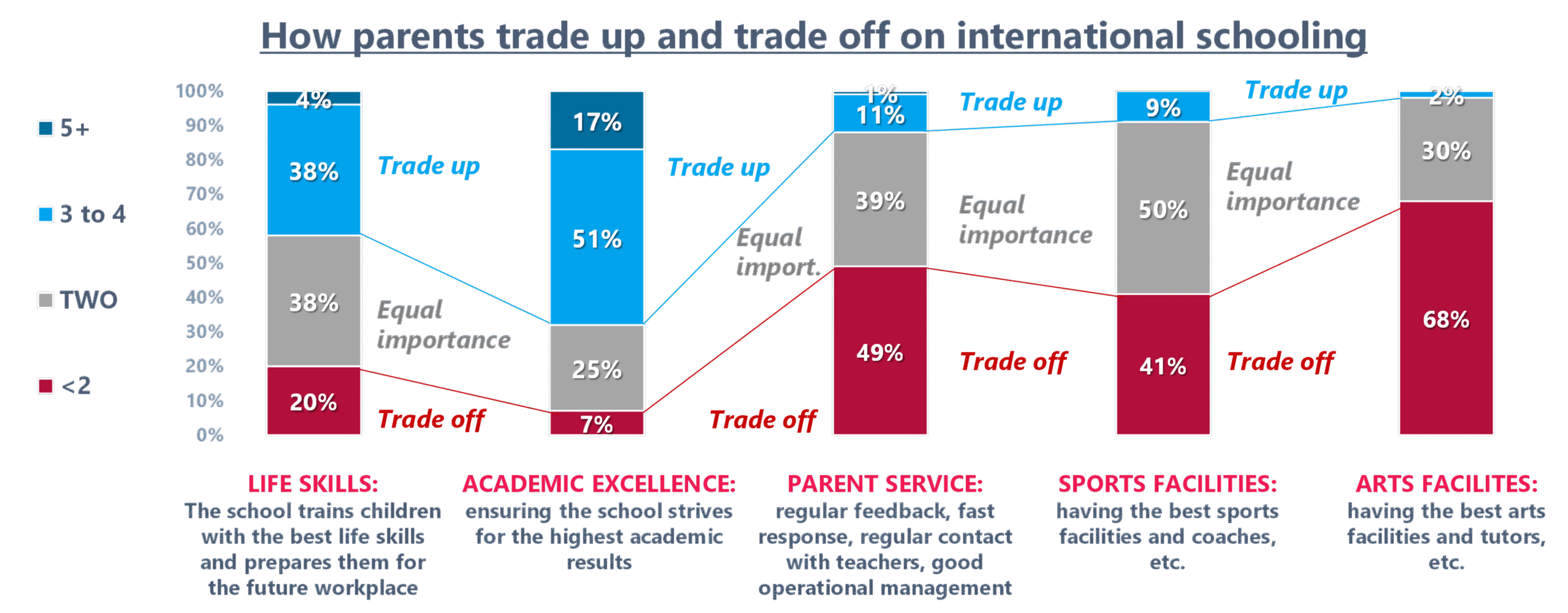
We are also able to drill down further into what elements of academics and life skills are important by undertaking further trade off exercises, again with the ‘easy to manage’ 10-unit exercise.
The other advantage to the trade-off approach is allows us to easily identify segments in the market that can be examined in more detail. Some schools are very strong in arts, and while most parents trade these facilities off, the one-in-three parents who think this is equally if not more import than other elements can be easily profiled and targeted.
While System 2 thinking is important for the international school category, some irrationality can still creep into the purchase decisions made by parents on schools. The ‘wow factor’ of some schools, e.g. the Olympic sized swimming pool, the theatre, the number of tennis courts, etc, can do a lot to swing parents’ final decisions towards the preferred school. Therefore, in parallel we also undertake derived importance analysis via brand imagery correlated with propensity to recommend school.