By, Novema Pte Ltd, May 2026
While 98% of market researchers now use AI, 95% acknowledge its technical limitations.
The most commonly cited issue is AI hallucination, identified by 60% of researchers. When combined with respondents who report AI adding incorrect wording, misleading descriptions, or inappropriate examples to findings, this figure rises to 69%.
Beyond hallucinations, 67% of researchers believe AI performs poorly in overall analysis. Common concerns include a limited understanding of complex products and markets, weak contextual interpretation of findings, insufficient business and marketing insight, and cultural bias. These limitations reflect the fact that AI systems are trained primarily on existing data and knowledge, much of which is heavily weighted toward Western consumer markets.
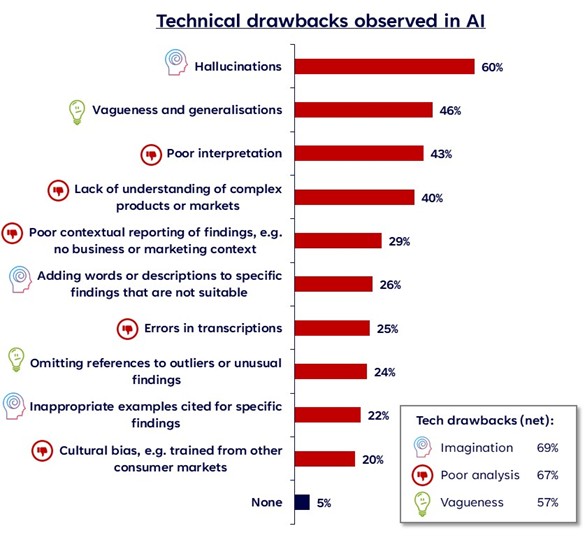
Another challenge is the so-called “curse of averageness.” Around 57% of researchers observe that AI outputs can be vague and overly generalised, often overlooking outliers or unusual findings. While future advances may reduce these issues, they remain a significant limitation of current AI systems.
In response to these technical shortcomings, nearly 90% of organisations have introduced some form of quality control. Almost half (49%) have implemented mandatory staff training based on company AI guidelines and policies. Meanwhile, 42% require formal disclosure of AI use to certain clients, and 28% conduct legal compliance checks for AI use on specific projects. Although these measures do not directly improve output quality, they may help organisations manage accountability and risk in the event of errors.
In addition, 65% of organisations have already developed in-house AI solutions as part of their quality control strategy. While almost all companies use marketplace AI solutions, only 17% report using formally accredited AI vendors, suggesting that most AI providers are not rigorously evaluated for model reliability. Indeed, 32% of stakeholders identify “disreputable vendors selling poor AI solutions” as a major drawback of AI, up from 21% citing this as a concern in 2024.
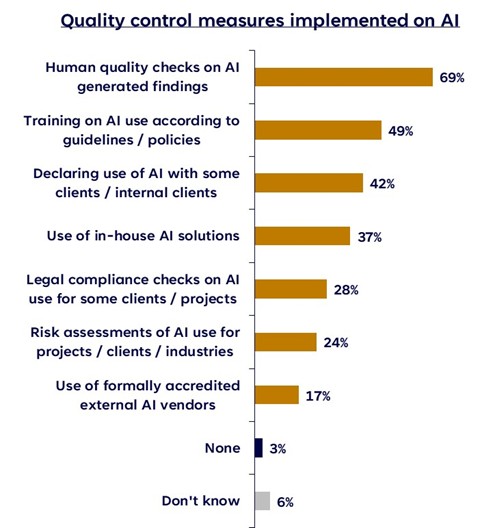
The most widely adopted safeguard, however, remains human quality control of AI-generated findings. The concern is whether the “attractive plausibility” of AI outputs may discourage researchers from questioning results critically, or whether time pressures may prevent sufficiently thorough review.
More broadly, the rise of AI is perceived to be affecting some of the core qualities of research itself. Around 78% of stakeholders identify “deskilling” as a major drawback, citing declines in critical thinking, weaker long-term strategic capability, and junior researchers bypassing foundational market research principles.
With 35% of industry stakeholders reporting that AI is already affecting jobs in market research, the future of consumer insight as a profession may appear uncertain. Headcounts across the industry are likely to decline, but a new generation of “AI-enhanced” researchers could ultimately become more skilled, productive, and commercially effective.