By: Piers Lee, Director, Novema Pte Ltd.
Customer loyalty research has evolved to recognise that few customers have true loyalty to brands. Research has shown that 94% of today’s brands could disappear without consumers caring, and 77% state they have no relationship with any brand.
The main factors that determine the continued usage of brands (so-called ‘loyalty’) are 1) habit, 2) general satisfaction that the brand delivers on customer needs, and 3) too much effort to change.

Brands do not necessarily need to ‘delight customers’ (except some luxury and high-tech categories), but they need to make the service interaction between the brand and customer as easy and effortless as possible. Hence many brands have switched from traditional loyalty measurement, e.g. Net Promotor Scoring, to assess ‘Customer Effort’ – the perceived ‘ease of use’ of the brand and their ability to ‘get jobs done’ for the customer.
Brands have therefore examined how to reduce the stresses, micro-stresses, and the various frictions customers have with using brands. At the same time, they need to make the onboarding of new customers as easy and effortless as possible within the purchase path.
These practices have raised demand for research into Behavioural Science, and with it specialist practices such as the BVA Nudge Unit within the BVA Group.
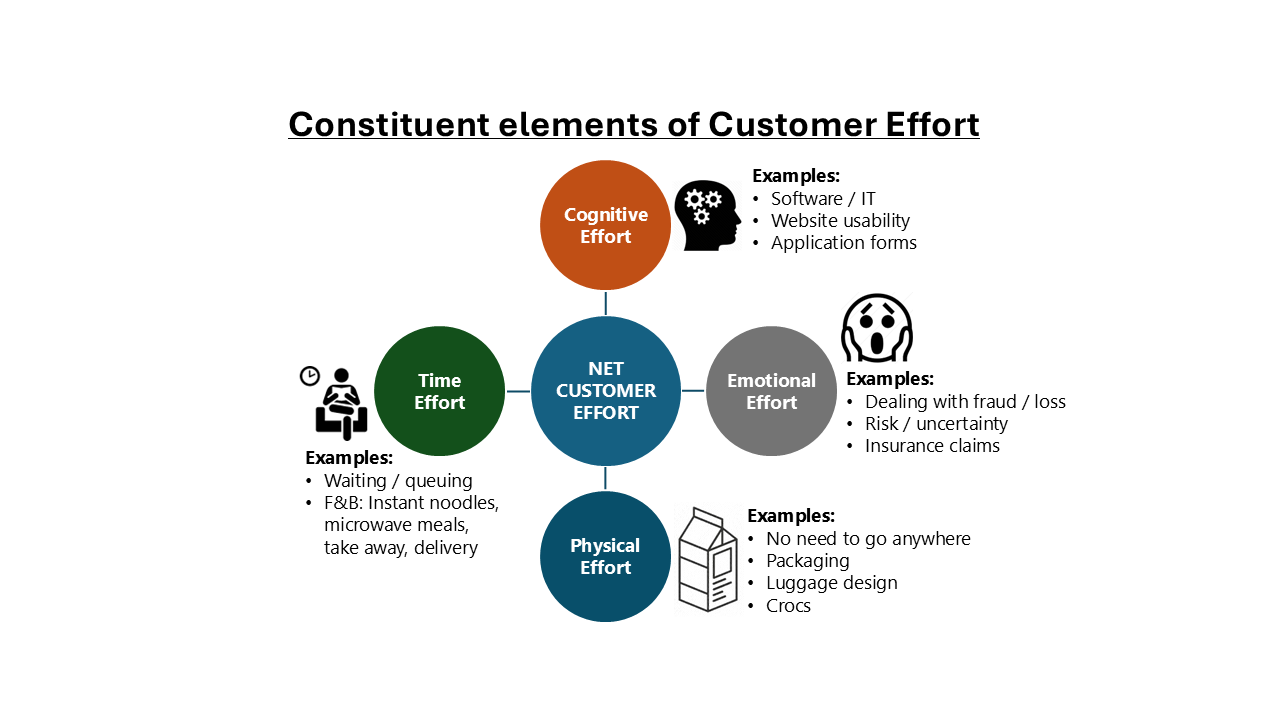
However, for brands to design their products and services to reduce customer effort, we need to understand more about its constructs.
An effective approach is to categorise effort into constituent elements that make up the Net Customer Effort, to include ‘Cognitive Effort’, ‘Emotional Effort’, ‘Physical Effort’, and ‘Time Effort’.
Customer interactions with brands can include expending effort in some of these constituent elements.
Some of the more ‘painful efforts’ for customers are in their expending cognitive and emotional effort, and hence these should be the areas that brands ought to pay most attention to.
The human brand likes to ‘power down’ whenever it can to preserve energy, hence most customers do not want to do ‘too much thinking’. Making your product easy to understand should be one of the main priorities, e.g. with software and IT. A lot of the Cognitive Effort can occur when a consumer first comes to using your services, hence the application process for taking out a new product should be as simple and straightforward as possible. Attention has to be given to the design of application forms, using layman language, making websites easy to navigate, and reducing the number of steps in the purchase path to completion.
‘Emotional Effort’ are the stresses endured by customers due to uncertainties and fear. Consider how much emotional effort is expended if you lose your phone or credit cards. If the telco or credit card company makes it easy for you to block the line or block the card, and makes it easy for you to get timely replacements, they have done a lot to reduce the level of emotional effort for the customer and will be rewarded by the customer accordingly.
Insurance products are designed to give ‘peace of mind’, e.g. cover in the event of accidents, poor health, or loss – these products directly serve the need to reduce a consumer’s emotional effort, e.g. if they are taking an overseas trip.
Some products require a level of Physical Effort to use the brand, that ranges from the smallest interaction such as the opening packaging to more intense interactions such as a driving a car for long periods. While the simple opening of packaging can seem a trivial interaction, have you ever got frustrated when you cannot open a jar or top of a bottle? These micro-stresses count when you can make a far lesser effort of buying the alternative brand on the shelf with more user-friendly packaging.
And finally, there is Time Effort – this is one of the more nuanced efforts that brands need to understand better. Generally, customers do not want to waste time, e.g. to travel somewhere to get things done (that also involves Physical Effort), and usually like things to be quickly. Certainly, we want to be able to see our doctor as soon as possible, and spend as little time in queues.
Fast food and instant food are product designs that takes away a need to wait tool long, for instant gratification, and takes away Cognitive and Time effort (in making a meal), although there are many who like cooking and therefore this passing of time is not stressful but instead enjoyable.
While many people like to bank online (taking away physical and time effort in going to the bank), some people might like ‘a trip to the bank’ as a means of breaking up their day by expending a bit of time and physical effort.
With the exception of quick service restaurants (that serve a need for speed), serving up food too quickly in a restaurant can take away some of the perceived value in the meal. A bit more time waiting means someone else is making the effort on our behalf – something we are willing to pay for.
One of the best examples of how Time Effort works in favour of a brand is with the Irish stout drink “Guinness”. In order to pour the ‘perfect pint of Guinness’, bar staff are encouraged to pour the drink in stages, usually taking a couple of minutes while keeping the customer waiting. This builds perceived value in the drink such that Guinness implemented a TV advertising campaign that was themed around the pleasures of waiting.
Hence, Customer Effort research program have to take into account the context of customer effort and whether some effort is actually pleasurable. The framework as described here is an effective way of diagnosing the type of effort from which good products and services can be designed to alleviate.