By, Piers Lee, Managing Director, Novema Pte Ltd
November 2025
Based on a survey of market research industry stakeholders conducted at the end of 2024, the top three perceived drawbacks of AI in research are its contribution to declining critical thinking among human researchers (including overly standardised outputs), the risk of errors such as hallucinations, and ethical concerns related to a lack of transparency and accountability in AI systems.
Linked to the decline in critical thinking, analysis that relies too heavily on AI may also lack the foresight and long-term strategic thinking that clients require.
The potential for AI to be wrong extends beyond hallucinations. For example, AI may fail to account for cultural or linguistic differences, and biases in training data can lead to the reinforcement of existing stereotypes.
Several commercial drawbacks are also recognised, including clients setting unrealistic expectations of AI, disreputable vendors selling low-quality AI solutions, and pressures that drive down fees.
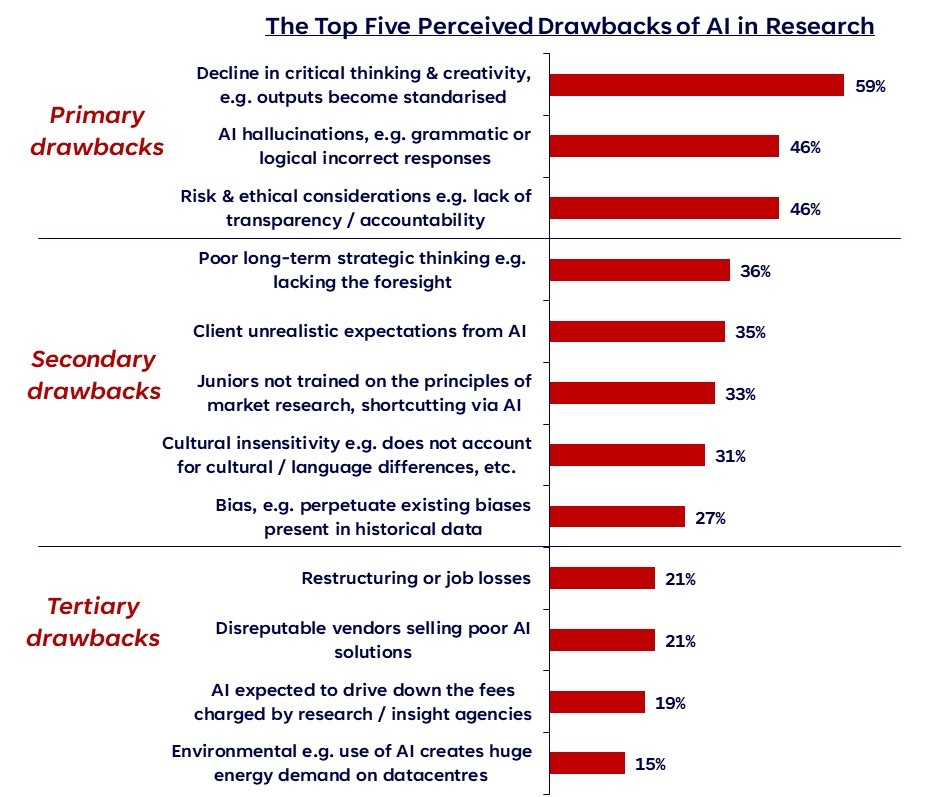
The negative HR impacts include job losses and the need for organisations to restructure, but an even greater concern is that junior researchers may not learn fundamental research principles if they rely on AI tools as shortcuts.
Only a few respondents felt that the environmental impact of AI is a major concern. However, many may not fully appreciate how much energy data centres consume, and this issue is likely to become more salient as it receives greater public attention.
The decline in critical thinking among researchers may stem from over-reliance on AI, which can erode core skills such as intuition and originality. As one participant noted, “You can look at articles on LinkedIn and you don’t know if the person used AI to write it, or how much originality is in the post.”
Generalisation issues, such as the “curse of averages,” may cause AI to overlook granular insights that could have significant implications. In qualitative research, AI also fail to capture subtle cues such as body language or emotional nuance.
Standardisation is another concern, particularly in downstream creative development: “We will go into a crisis of fidelity.” Overuse of AI without enriching its outputs could lead to generic, repetitive messaging in creative work.
AI hallucinations can produce plausible but incorrect outputs, leading to misleading results if not carefully checked. As one participant observed, “The outputs from AI are always seductively plausible, but they can be wrong.”
AI systems often lack traceability, making it unclear how or why certain outcomes are generated. This “black box” nature reduces trust, as users cannot easily understand what drives AI outputs or how biases might emerge.
As demonstrated in the AI analysis applied to this research, AI lacks the strategic thinking needed for industry-specific interpretation, contextual understanding, and “what if” foresight. However, this limitation highlights where the human element is essential—so it need not be a drawback unless human researchers are removed from the process entirely.
Younger generations risk bypassing foundational research training by relying on AI-generated answers without understanding how results are derived. This may lead to researchers becoming “lazy or complacent in their work.”
Models trained on limited or non-diverse datasets may reinforce biases. A lack of diversity in training inputs (e.g., dominance of certain groups such as “cis white men”) can exclude minority groups and cultural nuances.
Similarly, models trained in one cultural context (e.g., US data) may not transfer effectively to others (e.g., Japanese markets), potentially overlooking divergent trends or cultural distinctions.
A poor understanding of AI’s limitations may result in misuse or imprecise interpretation of results.
Some respondents expressed concern about disreputable vendors operating in the AI space. Beyond low-quality solutions, AI usage raises issues around data privacy and security, particularly when confidential client data is used for training. Bad actors could exploit AI systems, increasing the risk of hacking or misuse.
There is also the risk of mis-selling AI capabilities, where unrealistic client expectations, such as predictive accuracy or rapid turnaround, cannot be met.
While some suppliers fear that AI could unfairly drive down fees, some clients believe that AI may be misused by suppliers, for example by billing disproportionately for AI-assisted work that involves minimal human input.
Finally, although environmental concerns are currently the least prominent, this may reflect limited understanding of AI’s energy demands. Running AI queries, particularly through large language models, consumes substantial resources, and data centres are highly energy-intensive.
Drawbacks of AI to the individual researcher
Many of the individual researchers surveyed in this study fear not being able to gain a competitive edge through AI, partly due to the rapid pace of technological change and the errors inherent in AI systems.
Rapid AI adoption also brings change-management challenges, including resistance from individuals or organisations that are unwilling or unprepared to adapt to AI.
Some individuals may struggle with AI adoption, creating a skills gap or leaving them behind if they are unable to use AI creatively. As one respondent in the survey noted, “It is not that your job is going to be replaced by AI, but by someone who knows how to use AI in your job.”
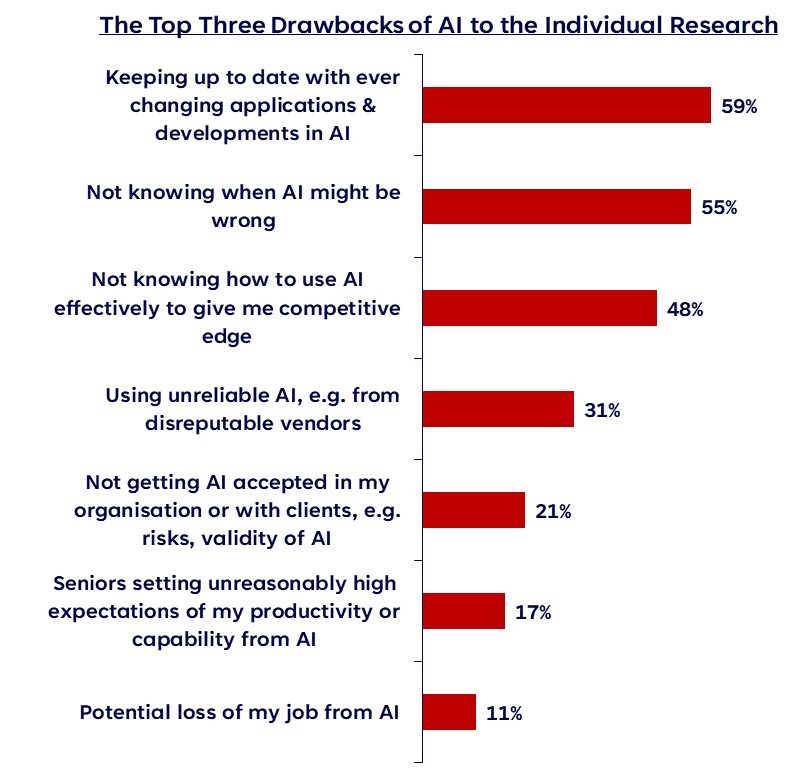
While there may be bad actors in the AI space, for example, vendors selling poor-quality AI solutions, and there are also concerns about whether researchers themselves can use AI properly. AI requires precise cues and training, yet users may not fully understand this, leading to misaligned or inaccurate outputs.
Senior management are more personally concerned about keeping up to date with ever-changing AI applications and developments (74%), whereas 59% of executives are more concerned about “not knowing how to use AI effectively to give me a competitive edge.”
Notably, there is little difference between senior management and executives regarding fears that AI will take their jobs—10% and 13% respectively.
In conclusion, the key concern among researchers and leaders is not that AI will replace their jobs, but that they may fail to keep up with AI’s rapid evolution and use it effectively, creating competitive disadvantages, skills gaps, and organisational challenges in adoption.