By, Novema Pte Ltd
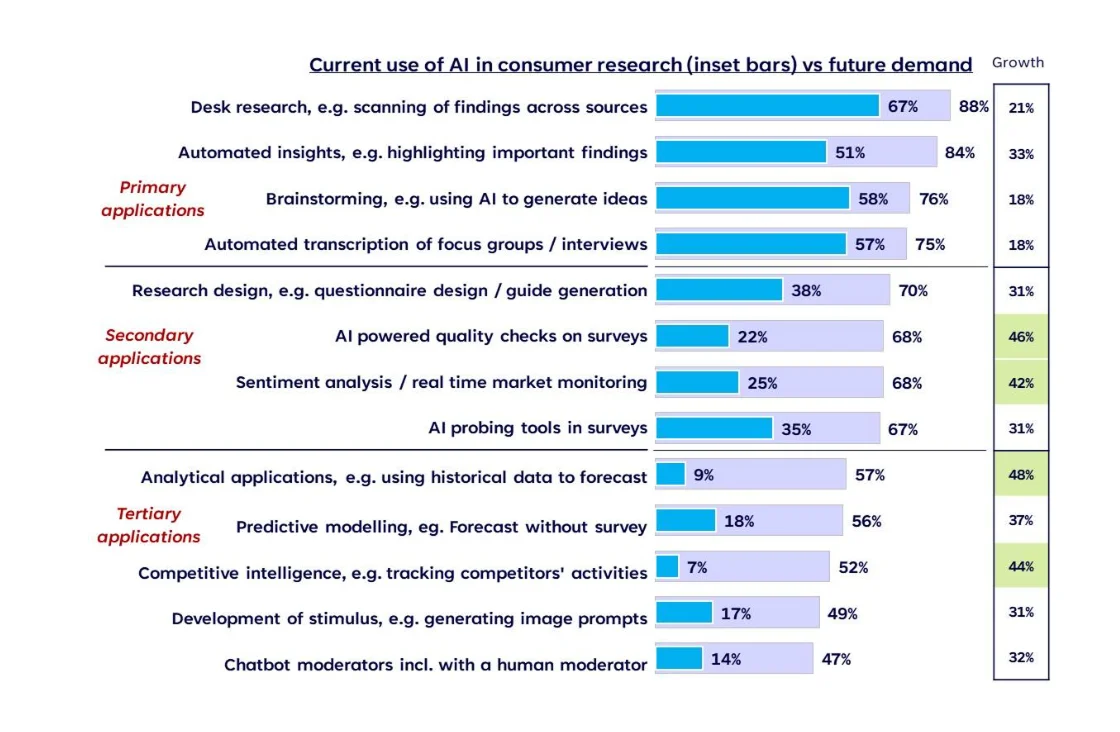
The leading applications of AI are in desk research, automated insight generation, brainstorming, and automated transcription, all of which is currently be used by at least half of organisations, and likely to be used by at least three-quarters within the next 2 years.
When comparing current and future use, the most growth can be seen in AI applications for quality checks, sentiment analysis, analytical applications, and competitor intelligence.
Net applications are summarized as follows:
| Transcription / Insights | 91% |
| Desk / Competitor Intelligence | 90% |
| Design | 89% |
| Moderation | 69% |
| Modelling / Forecasting | 68% |
Supply side use of AI
Applications of AI to desk research include document & paper scanning and analysis.
Many AI applications are designed to automate insights including analysis of open-end text for meaning beyond code counts.
AI tools to assist in notetaking, coding responses, and back-end tasks using tools like Coloop, Decipher, ChatGPT, and Perplexity.
In contrast, quantitative analysis relies more on human analysts for methods like K-means clustering, latent clusters, and max-diff, as AI is not yet trusted to make these strategic decisions.
AI is taking quality checks to the next level. Traditionally, online surveys would be quality checked via standard metrics like LOI, trap questions, and straight-lining. But AI applications like Machine Learning identify how engaged respondents are with surveys, and they can be ‘scored’ accordingly, e.g. whether to use their responses, or to even continue the respondent as a panel member.
AI is used to improve the survey experience for respondents including the use of AI probing tools. AI-driven tools (like LLMs) enhance surveys by mimicking “human-like” conversations. They ensure depth and focus on key study objectives, improving engagement and responses.
AI can be applied to a range of sentiment analysis, real time market monitoring, analytics, and modelling. Predictive models estimate outcomes, e.g., ad success, without even needing surveys and AI tools to analyse social media for insights.
Client use of AI
Newer brands can be more willing and able to adopt AI for their consumer insight. Compared to older brands, with established consumer insight practices, they prefer agile approaches by establishing in-house teams and capabilities to experiment with AI and avoid slower traditional market research agency processes.
Larger corporations can adopt AI more cautiously due to concerns around ethics, accountability, and responsibility in decision-making. The public sector can be the most resistant to AI use.
But more broadly, AI is seen as a tool to augment internal capabilities and enhance efficiency. But AI-generated outputs are scrutinized to assess risks, especially in sensitive industries like finance. Vendors using AI must undergo reassessment processes to ensure compliance and trust.
Clients see more risks in AI – this has made companies cautious in adoption, particularly in more regulated industries like finance or healthcare, and where implications of data breaches are that much more severe. Hence, ChatGPT can be ‘brought in-house’ (internal version). AI integration requires structured policies to ensure ethical usage and compliance.
Clients can be more active in AI use for desk research and competitor intelligence as these are often undertaken in-house.
Media companies have a huge amount of internal data on customers and are leveraging AI to obtain more insights.
AI is leveraged to analyze viewing habits and genre preferences to understand audience behavior and personalize recommendations. Some of this is on a ‘test & learn’ basis as it is not an exact science to “see of they react to things differently.” – challenges emerge in applications to different countries and cultures.
Other challenges arise in understanding light users or mixed profiles due to insufficient or noisy data, such as shared accounts leading to skewed insights and poor recommendations for light users.
AI is often used in conjunction with primary research to enhance understanding of customer journeys and dissatisfaction areas.
Marketing teams are using AI in the innovation process, in media targeting, real time modification of creatives and messaging, targeting specific segments.
Use of AI-assisted solutions
ChatGPT has become the AI industry leader by a considerable margin, but firms are using a range of other applications, with some brands having achieved a market lead in AI including Displayr, Qualtrics, CoLoop, Perplexity, Anthropic / Claude, and Indeemo that have already been used by 10% or more of research agencies.
Based on n=108 surveys, an astonishing n=44 different AI branded solutions have either already been used or expect to be adopted in the future!
There is an appetite for most firms to develop their own in-house AI applications. The preference is to develop these in-house (57%) rather than with an external vendor (35%), showing that confidentiality and ownership of the IP are important to research firms. Smaller firms like to use external vendors for many of their supply functions (including AI), so that they can remain as lean as possible and focus only on the advisory business.